I've never voted in my life. Not because I don't care, but because of my legal status. I left Japan when I was 15 (way before I took interest in politics), and I was on a student visa from 15 until 24, then on a work visa until 27, then obtained my permanent residency or green card (which, by the way, is not green). As a resident alien (title I love), I can work and therefore required to pay taxes, but two things I can't do is vote and serve on a jury duty. The latter is perhaps a gift in some ways (though I realize it's an important civic duty), in that I can just write "not a citizen" on a post card and not worry about getting out of work or being stuck in a difficult case for days, but the not being able to vote is tough.
Especially today.
There are issues at stake that are important to me and people around me as I have spent nearly 30 years in this country. I wish so much that I could express my voice in a form of a vote, but I can't. People have asked why don't I just become a citizen. It is a logical question to them, but very complicated, emotional question to me and I choke on the answer every time. One is the identity. As most of my family is in Japan, I am still very much connected to my home country, despite the fact that I have been in the US twice as long. I think it's because that is my origin of my being, where I was raised in my formative years, where the house I grew up is (with people who raised and grew up with me in it), and where I go to be with the people who really know my true colors, and ground me in between my adventures. Changing citizenship would feel like I am throwing away all of that and severing my roots from my body. That's not necessarily true and it sounds dramatic, but that is how it feels.
The other is the practicality. If Japan offered the option of a dual citizenship as many countries do, I would probably obtain citizenship in the US. But Japan doesn't, so having a green card is the closest thing to having dual citizenship. Should something happen to my family in Japan, I could go and stay longer than a tourist would be able to and have the rights to do things that visitors don't. Should some situation arise in the US where I felt unsafe, I could take my daughter there. And that is another thing--opportunity for my daughter. Because I am a Japanese citizen and her father is a US citizen, she has both. She can have that until she is 22 and she has to chose. At this point, she is likely to chose the US citizenship which is what I expect and am fine with, but should she choose to go study in Japan during college, she can have the benefit of a citizen and possibly work there, etc. It opens up more choices for her.
Most Japanese people I know in the US keep their green cards like I do for similar reasons. We're not an immigrating people anymore. The wave of Japanese farmers that came over (a.k.a Isseis) in the 1800s came for better life like all the other immigrants. But then there was a period of time in the US that banned Asians from immigrating and after that was WWII when Japanese immigrants and Japanese Americans were interned which caused all kinds of emotional turmoil about where they belong. Then Japan rebuilt during post war and became big and strong (I apologize for this totally over simplified history, BTW) so the need to immigrate went away for the most part. Now, Japanese people who come to the US are either for school or if their company sends them. Most of them go back. Handful of them don't--like me. Coming here changed my life. It opened doors that I couldn't have imagined and it helped me to find who I am. Not to mention I would have never met my husband who thinks I'm funny. That alone is a life changing event. I care deeply for the future of this place and I work hard every day to contribute in gratitude. Yet I have no voice because of the choices I made. It's hard being me, I know.
So I can engage in conversations and perhaps inform people who might be on the fence. I can give money or my time to places that I believe is going to do some good or doing great goods. Maybe things will change for future elections for me but for this one, I have to once again sit on the side line and just route.
Do the right thing, America. I believe in you.
Tuesday, November 6, 2012


Thursday, September 13, 2012
Bento Marathon
I think the word "bento" has become somewhat familiar to certain Americans these days. For those who are unfamiliar, bento is a boxed lunch, unique to Japanese culture (if you want to totally nerd out, click HERE). As I have written a lot in the past, we take our food seriously and so it is important for us to have good food even when we are on the go. There are all kinds of bento to be had all over Japan for all occasion. But what I want to focus here today is the kind mothers have to pack for their children to take to school. Let me paint you a picture.
Moms in Japan take pride in their cooking. That is not to say that there aren't any dads who cook (for instance, my brother is an excellent cook), but there is an enormous pressure for moms to cook well. And bento that they prepare for their children says everything about how much they care about their children's well being. It is a status thing and a point of pride. And if you don't prepare a perfect bento, you have failed as a mother. That is of course not true, but that is what they think. I have a friend who is a high-powered career woman who gets up at 5:00 a.m. to prepare her daughter's lunch everyday. Then she puts breakfast on the table for her family, gets herself and her daughter ready and puts her on the right train (kids who go to private schools commonly commute on subways--I was one of those kids) and gets in to work by 9:00 a.m. If that were my schedule, I would be asleep at my desk by 9:25. She said she went to the first parent meeting and the teacher said, "You are going to be preparing bento for the next 12 years. Mothers, pace yourselves." This is how seriously moms take it.
The most important bento of all during the school year is for the annual Field Day. The whole family comes out to watch various sporting events in which all kids are forced to participate and the bento that each family brings is the statement of the family. Moms have to totally put their game faces on and do some serious cooking to not shame the family.
Up to this point, I did not have to prepare bento on a regular basis because my daughter's Japanese preschool served the most delightful, well balanced, home cooked Japanese meal every day. But that is no longer the case for me BECAUSE MY DAUGHTER STARTED KINDERGARTEN. I realize I live in the States and no one expects me to make a perfect bento everyday (and many won't even know the word), but I feel the need to do at least a decent job in following my cultural tradition. It must be my DNA. So I went to the local Japanese book store and purchased a bento cook book. Yes, there is such a thing and the section on that topic was pretty sizable that I stood there for good 15 minutes selecting just the right book that was at my skill level.

Photo of said book
One of the most common and beloved Bento item is called omusubi or onigiri, which translates to "rice ball." They looks like this:

The standard shape it triangle and we make these by hand. You wet your hands, put some salt on the palm of one hand and scoop some rice onto your hand and gently make this shape with your hands and toss it in circle until it becomes this shape. We all learn to make these at some point in our lives. You can make them plain or put something in the middle, like a small piece of grilled salmon, pickled plum (also shown in the first photo above), and a bunch of other things. You have three of these and can call it lunch. Delicious.
This is a side note but we love it so much that convenient stores all over Japan now has a huge section of nothing but these with many different ingredients

This is one really delicious and cheap way to eat in Japan, just so you know.
There is a film called Kamome Shokudo (excellent food movie, by the way), in which, the woman who runs the diner refers to onigiri as "Japanese Soul Food." My daughter will always eat these no matter what. So that is the first thing I packed. The important thing in obento is how you present the food. If you want to go nuts, you can do things like this:

Who has the time and patience to do this before 8 a.m.?

OK, this is kind of amazing.
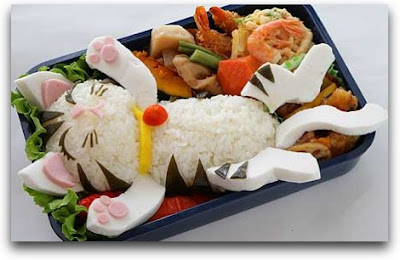
Seriously, people need to stop.
Or you can go totally simple and cheap and prepare the most traditional bento:

This, I can do.
This is called "Hinomaru (Japanese Flag) Bento." It's rice with Ume (pickled plum) in the middle. That's it. This was popular during war time or in the rural country side back in the day. Nothing fancy, just some starch to get through the day. I think the equivalent is like having a boiled potato. Might be just stylish. Or totally unbalanced.
While I would like my daughter to take joy in eating, I am also realistic and know my limitations so I will do what I can to give her a fun looking lunch. It's a part of my culture I enjoy and want her to also appreciate it, if not now, down the road.

What's achievable: salmon musubi, chicken karaage and carrots in stackable bento box

How it looked in her lunch box on her first day
Sunday, August 5, 2012
Olympic Pride
I love the Olympics. Not to be all cheesy but it's an event in which people feel national pride, root for their country and unite in... well, watching TV, I guess. It's also always eye opening as to where our country stands in comparison to others in the world of sports. And I realize, at the same time, that my world geography is terrible.
It is difficult to catch any footage of Japanese athletes in the U.S. unless they were in the events in which the U.S. was also strong. The first Olympic I experienced here was in 1984, my first summer after moving. I spent 10 weeks working at a horse-back riding summer camp in the middle of nowhere in California because I felt I would lose my freshly acquired English if I went home for two and a half months. I was a nerd. My mother's friend in California who lived near my boarding school recommended this camp to me and there I was, working in the kitchen, cleaning horse stalls, milking cows and mingling with American kids. There was no TV there and we were in bed by 9:00 pm and up by 5:30 am. I was 16 and clearly didn't know better. My mother sent me newspaper clippings of how Japan was doing while it was happening and my parents also recorded the opening ceremony on VHS and sent it to me to watch when I got back to school. I felt removed and home sick, but also was having such a great time that all of that seemed less important than it had been. I kept the clippings in my journal (ah, journal keeping).
Every Olympics since then is just a series of "What's happening with Japan?" I would watch the screen like a hawk to spot a Japanese athlete and track them in the background. If they are close to any Americans competing, I would hang on to every word being said about them. If they did any kind of a feature on a Japanese athlete, I would automatically tear up as if I were related to them. I felt that if TV in the U.S. was mentioning them, my country was noticed at that moment. In occasions like that when you realize how your culture is viewed in a foreign land, you hope that people have a good impression.
Then came the winter Olympics in Nagano in '98. I remember that whole "emphasis on the first syllable" pronunciation lessons by NBC and I remember thinking "that's nice that they care." I received a phone call in the midst of that from someone I only sort of knew who put me on the speaker phone to ask what I thought of that. He explained that he was with his colleagues and one of them who is Japanese felt this was not 100% accurate and this sort-of-friend wanted to know my take. I told them that I felt touched that NBC would be so culturally sensitive and put efforts into pronouncing it correctly. I said it's a heck of a lot closer than how it has been pronounced (with the emphasis on the second syllable as that is the natural tendencies for English speakers) and really, who cares? He later told me that this Japanese dude he knew was a total jerk and he wanted another Japanese person to challenge him. Ugh. How embarrassing.
I remember watching the opening ceremony, which was oddly in the daytime there to accommodate the prime time TV airing in the U.S. (or some such reason), and was once again beaming with pride. They opened the whole ceremony with a then-famous sumo wrestler who held the highest honor and status as far as athletes in Japan performing a ritual to bless the event.


But it was exciting to witness my home country host this and sad that I was not there to share the Olympic fever. Or buy any goods.
The worst though was the Vancouver Olympics figure skating. If you recall, Kim Yu-Na, super cute South Korean skater took the gold which was unusual and exciting. Mao Asada of Japan took silver. Then a Canadian skater Joannie Rochette took Bronze and because she was local and Kim Yu-Na was sensational, they covered more of those two during the medal ceremony. In fact, there was no shot of Mao Asada. Like she was not there. I actually said, "Oh come on!" Granted, Japan took gold in Turin and we got all kinds of coverage then but still. SHE GOT SILVER AND I THINK YOU CAN MAYBE SHOW HER FOR A SECOND WITH HER MEDAL. Sigh.
This time around, however, technology is on my side. I can now stream Japanese TV in real time on my computer. Not to mention the amount of websites available that will tell me how every athlete from Japan is doing at practically every moment. It is bliss. Of course with all of that PLUS the American coverage, I am not getting anything done but dammit, I am following my fellow countrymen who are doing their thing.
Japan has been depressed since the earthquake and there is a lot of "What's going to happen to our country?" feelings floating around so we could use some pep. Just yesterday, in the men's 400 medley relay in swimming, Japan took silver. You may not have noticed this so much because Michael Phelps was also swimming his very last Olympic race and his team took gold. But this silver was huge for Japan. Kitajima, who has competed in the Olympics in the past did not earn any medals this time around and since this was his last one his teammates said, "We can't let him go home empty handed." So they swam hard and won a silver medal for him to take home. See? That is a good story. Thank you, internet streaming.
I am certain that I am not the only one who is rooting for my home country, the U.S. being the melting pot and all.
I can only imagine what technology will provide in the future.
It is difficult to catch any footage of Japanese athletes in the U.S. unless they were in the events in which the U.S. was also strong. The first Olympic I experienced here was in 1984, my first summer after moving. I spent 10 weeks working at a horse-back riding summer camp in the middle of nowhere in California because I felt I would lose my freshly acquired English if I went home for two and a half months. I was a nerd. My mother's friend in California who lived near my boarding school recommended this camp to me and there I was, working in the kitchen, cleaning horse stalls, milking cows and mingling with American kids. There was no TV there and we were in bed by 9:00 pm and up by 5:30 am. I was 16 and clearly didn't know better. My mother sent me newspaper clippings of how Japan was doing while it was happening and my parents also recorded the opening ceremony on VHS and sent it to me to watch when I got back to school. I felt removed and home sick, but also was having such a great time that all of that seemed less important than it had been. I kept the clippings in my journal (ah, journal keeping).
Every Olympics since then is just a series of "What's happening with Japan?" I would watch the screen like a hawk to spot a Japanese athlete and track them in the background. If they are close to any Americans competing, I would hang on to every word being said about them. If they did any kind of a feature on a Japanese athlete, I would automatically tear up as if I were related to them. I felt that if TV in the U.S. was mentioning them, my country was noticed at that moment. In occasions like that when you realize how your culture is viewed in a foreign land, you hope that people have a good impression.
Then came the winter Olympics in Nagano in '98. I remember that whole "emphasis on the first syllable" pronunciation lessons by NBC and I remember thinking "that's nice that they care." I received a phone call in the midst of that from someone I only sort of knew who put me on the speaker phone to ask what I thought of that. He explained that he was with his colleagues and one of them who is Japanese felt this was not 100% accurate and this sort-of-friend wanted to know my take. I told them that I felt touched that NBC would be so culturally sensitive and put efforts into pronouncing it correctly. I said it's a heck of a lot closer than how it has been pronounced (with the emphasis on the second syllable as that is the natural tendencies for English speakers) and really, who cares? He later told me that this Japanese dude he knew was a total jerk and he wanted another Japanese person to challenge him. Ugh. How embarrassing.
I remember watching the opening ceremony, which was oddly in the daytime there to accommodate the prime time TV airing in the U.S. (or some such reason), and was once again beaming with pride. They opened the whole ceremony with a then-famous sumo wrestler who held the highest honor and status as far as athletes in Japan performing a ritual to bless the event.
Side note: this wrestler, Akebono, is not even Japanese. He is Polynesian.
Okay, so the figure skater Midori Ito lighting the torch was both moving and awkward in that she looked like a super hero yet seemed trapped by her costume:
But it was exciting to witness my home country host this and sad that I was not there to share the Olympic fever. Or buy any goods.
The worst though was the Vancouver Olympics figure skating. If you recall, Kim Yu-Na, super cute South Korean skater took the gold which was unusual and exciting. Mao Asada of Japan took silver. Then a Canadian skater Joannie Rochette took Bronze and because she was local and Kim Yu-Na was sensational, they covered more of those two during the medal ceremony. In fact, there was no shot of Mao Asada. Like she was not there. I actually said, "Oh come on!" Granted, Japan took gold in Turin and we got all kinds of coverage then but still. SHE GOT SILVER AND I THINK YOU CAN MAYBE SHOW HER FOR A SECOND WITH HER MEDAL. Sigh.
This time around, however, technology is on my side. I can now stream Japanese TV in real time on my computer. Not to mention the amount of websites available that will tell me how every athlete from Japan is doing at practically every moment. It is bliss. Of course with all of that PLUS the American coverage, I am not getting anything done but dammit, I am following my fellow countrymen who are doing their thing.
Japan has been depressed since the earthquake and there is a lot of "What's going to happen to our country?" feelings floating around so we could use some pep. Just yesterday, in the men's 400 medley relay in swimming, Japan took silver. You may not have noticed this so much because Michael Phelps was also swimming his very last Olympic race and his team took gold. But this silver was huge for Japan. Kitajima, who has competed in the Olympics in the past did not earn any medals this time around and since this was his last one his teammates said, "We can't let him go home empty handed." So they swam hard and won a silver medal for him to take home. See? That is a good story. Thank you, internet streaming.
I am certain that I am not the only one who is rooting for my home country, the U.S. being the melting pot and all.
I can only imagine what technology will provide in the future.
Subscribe to:
Posts (Atom)